Narangi ya Nimbu?
Channapatna.
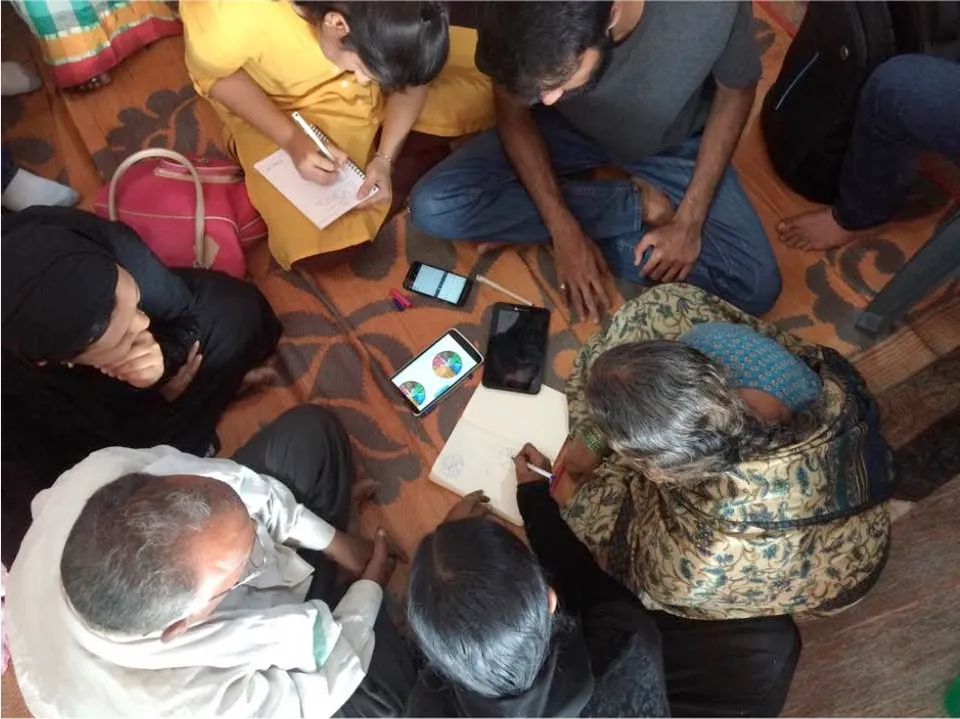
The setting was the living-cum-bedroom of a sixty-year-old woman, who was living with hypertension and diabetes, along with her husband, two adult male children, their wives and children. Her husband; Tabassum the Health Navigator (HNs as they are called, are community health workers trained and supported by MAYA, a not-for-profit organisation based out of Bangalore); three students who worked on the design mock-up of an app running on the tablet enabling collaborative practice of healthy eating between the HNs and their community members (an idea that emerged from Tabassum’s experiment with a physical diet chart); and I were present. We were there to try out the possibility opened by the mock-up of the app for collaborative conversations between Tabassum and her client.
Tabassum explained the idea and the plan for the session in Dakhani and invited the woman to be part of the session. She opened the app on her tablet and mapped the daily food intake of the household. The discussion then moved to the idea of an “ideal” diet, and the woman and her husband both mentioned that they should eat more fruits, more leafy vegetables, and reduce red meat and fatty foods, nodding their heads to what they (and we) have learned about healthy diets in general. When it was time to decide what food item the woman would reduce or replace, there was a conundrum. The woman mentioned that she cooks mutton kheema-ball curry three times a week and eats it for both lunch and dinner on those three days, which she knows is quite bad for her health, and she wants to reduce it. Tabassum asked her if she wants to reduce it to twice a week. The woman said no. Can she eat it only for lunch? No, not possible. She needs to feel the taste of it to be able to sleep. Then Tabassum asked, “How many balls do you eat each time?” Two. Can she reduce it to one ball or serving per meal? No. She likes to have two. Ever patiently, Tabassum asked, “What is the size of these balls, narangi ya nimbu [orange or lemon]?” The woman replied, “Narangi.” Tabassum, with a smile, asked, “Can you make the balls lemon size rather?” The woman replied with a yes. Finally. The app and the tablet are completely in the background, as this negotiation unfolds.
I love exploring and teaching histories of the imaginations of Humans and Digital; I have been crafting a learning unit around this at Srishti since 2018. “Those who (have the privilege to) create, get to name it” said one of the students from the 2019 version, while we were collectively reflecting on why the objects in Buxton’s Collection are named so. A name holds the imagination of what role a technology should play, and how it is to be used; a ‘mouse’, a ‘lap-top’, a ‘smart’-phone. Artificial Intelligence.
Prof John McCarthy interjects professor Sir James Lighthill in the brilliantly insightful Lighthill debate, to state how he and others coined the term Artificial Intelligence “as we had to do something when we were raising money for a summer study (everyone laughs) in 1956”. Driven by metaphors from the familiar world, the technological objects were imagined and named by particular people under very specific circumstances and contexts. For example, multiple metaphors of Artificial Intelligence capture specific imaginations encoded in their production by specific technologists, who are from and are situated in the labs and centres of innovation in so-called Global North. The metaphors and imaginations they hold are the technologists’ responses to specific (Silicon Valley, White, etc) socio-cultural and technological pasts, realities and desires for the futures. Yet, the names of the objects and devices and what they are supposed to mean continue to shape the way we in the larger world imagine and use them.
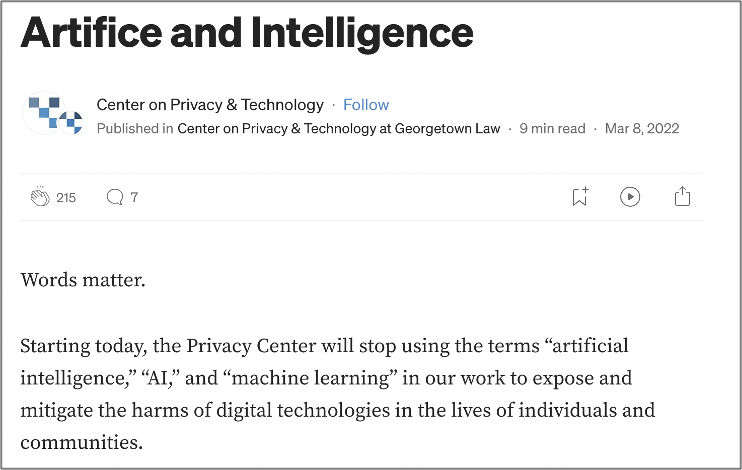
Drawing from Emily Tucker, the Executive Director of The Center on Privacy & Technology at Georgetown Law, Lucy Suchman challenges us to question and trouble the emerging works of Artificial Intelligence technologies and their critique, both which stabilise and take for granted the imaginations and metaphors that have come to be inscribed in the term “artificial intelligence”.
Words matter. They carry specific imaginations of specific worlds. What if we forget the current metaphors driving the imagination and creation of Artificial Intelligence? What if, like Emily Tucker, we do not use the terms “artificial intelligence”, “AI”, and “machine learning” in our work?
I am part of a collective of individuals and organisations belonging to, and working in places with rich, plural forms of living and being. People in these places—Bidar, Channapatna, and Kundapura— hold rich lived and practiced knowledge about food and health, about farming and being climate resilient, and about the multi-layered and multi-form arts and crafts practices. Folk and traditional forms as well as new forms of creating and sharing lived experiences in the forms of creative writing (in and for regional languages), oral storytelling, performance arts, textile arts, musical arts, etc, have evolved with and through a range of technological advances in our places.
We have been wondering about what if the imaginations of advanced technologies emerge from the people and places they live and work from. What if the imaginations are from the people who have been making, crafting, expressing, working with a range of technologies as part of everyday life historically, and co-shaping both the technologies and their own creative practices? What kind of human-technology relations and forms could such imaginations hold, and bring forward?
Our broader vision is to foreground and make visible the technological imaginations rooted in the everyday practices of the people who are placed on the many 'margins and peripheries'—gender, caste, profession, education, class—of the mainstream society, whose very use of technology, digital and material, hold rich plural possibilities for plural, alternative, more-than-human worlds.
Since 2019, we have co-constructed alternative imaginations in Bidar and Channapatna, as cross-threads for continuous and evolving explorations of futures. Building on, Micah Alex, Shreyas Srivatsa and I, over many Discord conversations, together framed the initiative of Local Techno Futures, where we are currently working with four women and a pair non-binary art and craft practitioners in Bidar as resident artists. The initiative is in collaboration with Melissa Densmore and Nervo Verdezoto.
Adhavan, my colleague, and I, are working with Narasappa Bhooteya is a non-binary performative artist from the Bhooteru community, practising Gondhal, an experiential performative art in honour of the Goddess Bhavani usually extending the entire night. We are understanding and collaboratively describing the worlds of Narasappa as the ground to co-construct alternative imaginations: What words, as metaphors, could Narasappa’s life-worlds offer us to co-imagine plural relationships between Narasappa and technological artifacts? We are currently co-constructing ways to enable Narasappa to augment the Tuntuni (the one string instrument that Narasappa uses while performing) with digital recording and local archiving possibilities. In this material speculation, we hope to wonder about the possibilities of Narasappa augmenting their practice with digital archiving tools that enhance, rather than replace, Narasappa’s role as a living, embodied archive of folk stories and songs linking more-than-human worlds?
We are situating this material speculative exploration in the personal histories and present of Narasappa as well as enmeshing it with specific counterfactual histories of socio-political evolution of technology in pre-and post-independent India. The resulting artifacts and speculative fictional worlds we co-produce with Narasappa will become a chapter in the Book of Local Techno Futures.
Book of Local Techno Futures is a multilingual publication in the languages of Dakkhani / Urdu, Kannada, and English, which contains curated themes organising the fictions co-produced with the resident artists from South Africa (with Melissa and Oceanview community) and India. The book will be in the form of multiple media, where each fiction will stay true to the creative practice of the individual resident practitioners, accompanied and annotated with text, images and material artefacts co-produced with the resident artists. Book of Local Techno Futures is our vision of co-building and sharing plural imaginations: metaphors, words and worlds, all co-existing in solidarity with each other, as Ruha Benjamin calls for.